A Sydney furniture studio's rebuilt site converted for months before the owner ran his own Google Ads. In April 2026, with the owner running his own Google Ads to the first site we built for him, online revenue that month was about 6× the seven months before combined, by the owner's own count. This was before the current system existed. The owner's ads brought the traffic, and the site we built caught it: fix what converts before you pay for a single click.
Ads buy traffic. The page decides what it is worth
In most cases the ads are working. They buy traffic, and traffic is cheap. The money dies on what the traffic lands on. When the page does not carry the brand, the enquiry hits a dead inbox, or nobody answers the listed number, more spend just buys the same leak at a higher volume.
AI made it trivially cheap to build a business's entire front end. That is exactly why almost no one's results got better. The last two years handed everyone the same tools. Anyone can generate a website in an afternoon. Copy, a brand, a hundred product images, an ad campaign, before lunch.
So everyone did. And most of them are staring at the same dashboards they had before, wondering why the traffic they bought never turned into money.
When the building gets free, the building stops being the advantage. The separation moved to judgment. What to build, in what order, and what "good" means for this one business, decided before a single dollar goes to ads.
The case: a furniture studio with real craft and no funnel
Last year we took on a furniture studio in Sydney. Decades of real craft, almost no online presence, a site that caught nothing. We rebuilt the whole front end in about two weekends, positioning, offer, brand, site, and product imagery, most of it with AI in the loop. The build was the easy 80%. What made it pay was three decisions the AI could not make.
Decision one: postulate first, then send the machines
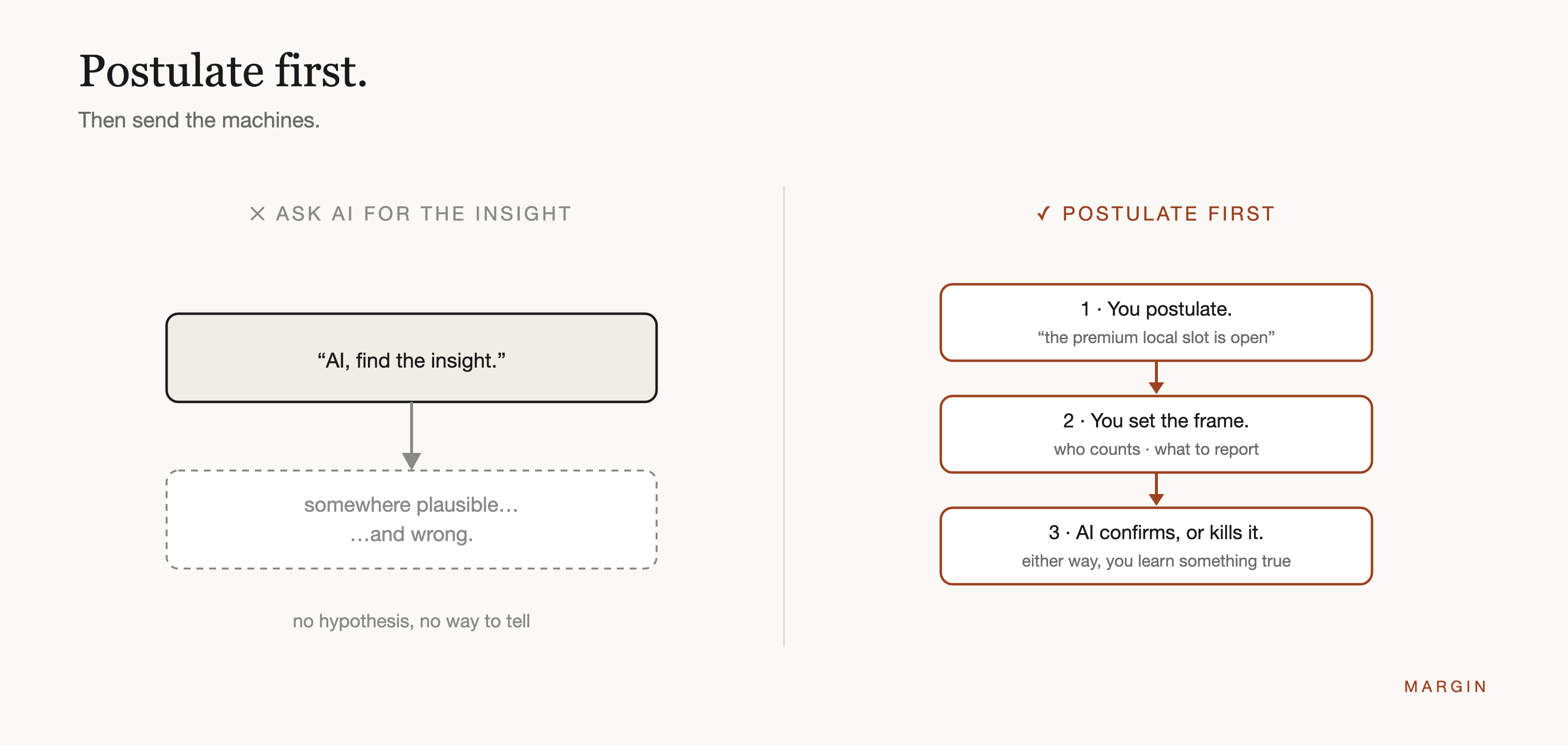
Form the market hypothesis yourself, then use AI to confirm or kill it. We postulated from Alex Hormozi's $100M Offers playbook and the studio's own customers that the generic middle was crowded and the premium local slot was open, then sent AI to scrape the competitor field inside a frame we set.
Which businesses count (local, high-end, comparable size). What to report on each (positioning, pricing, catalogue, channels). The scrape existed to test our hypothesis, not to invent one.
Hand AI the deciding and it will take you somewhere plausible and wrong. It is a phenomenal collector and pattern-finder. The postulate, and the reading of what the pile means, stay human.
Decision two: seal the funnel, then pour
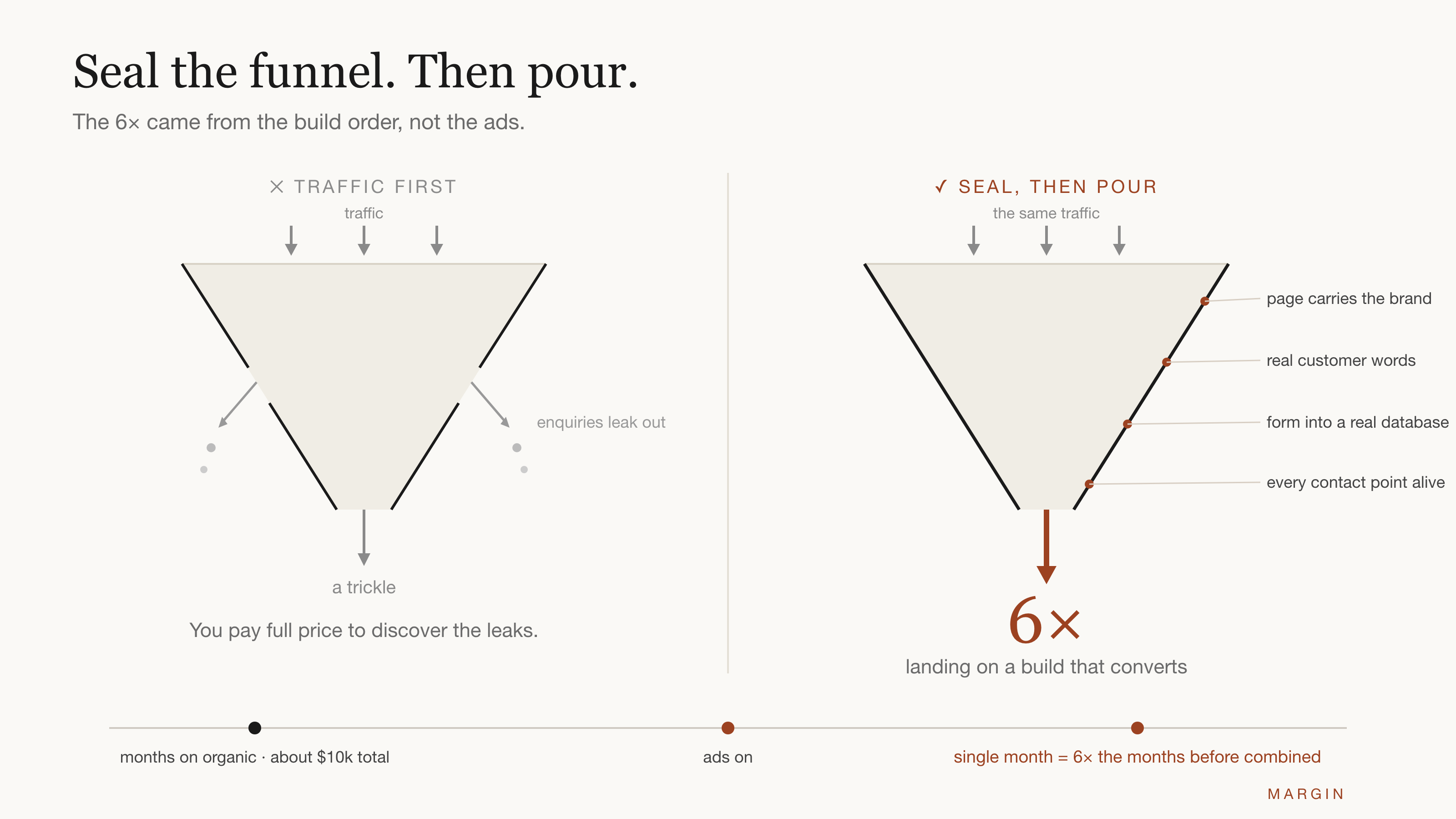
Build everything that converts first, as one path, and let everything else wait. A visitor should land on a page that sells, reach a form that works, and get an answer. In this build that came down to five parts, in one batch:
| Built in the first batch | Why it went first |
|---|---|
| A landing page that carries the brand: the prestige, the decades, the process | The first five seconds decide whether a stranger stays |
| The best pieces, rendered in the right light and settings | People buy what they can picture in their home |
| Copy mined from real customer enquiries, in the customers' own words | The language that already sells, reused |
| A form and booking that land in a real database, not a dead inbox | An enquiry nobody sees is revenue nobody gets |
| Every contact point alive: locations, phones, emails, showroom | Whoever answers first wins the job |
Catalogue depth, the owner's story, and the blog all waited. Browsing does not pay for the rebuild. Converting does. If losing an enquiry sounds cheap, the missed-call ROI calculator will change your mind in about a minute.
Make sure the funnel is not leaking before you move traffic in. Do it backwards and you pay full price to discover the leaks.
Decision three: generate offers in batches, choose with taste
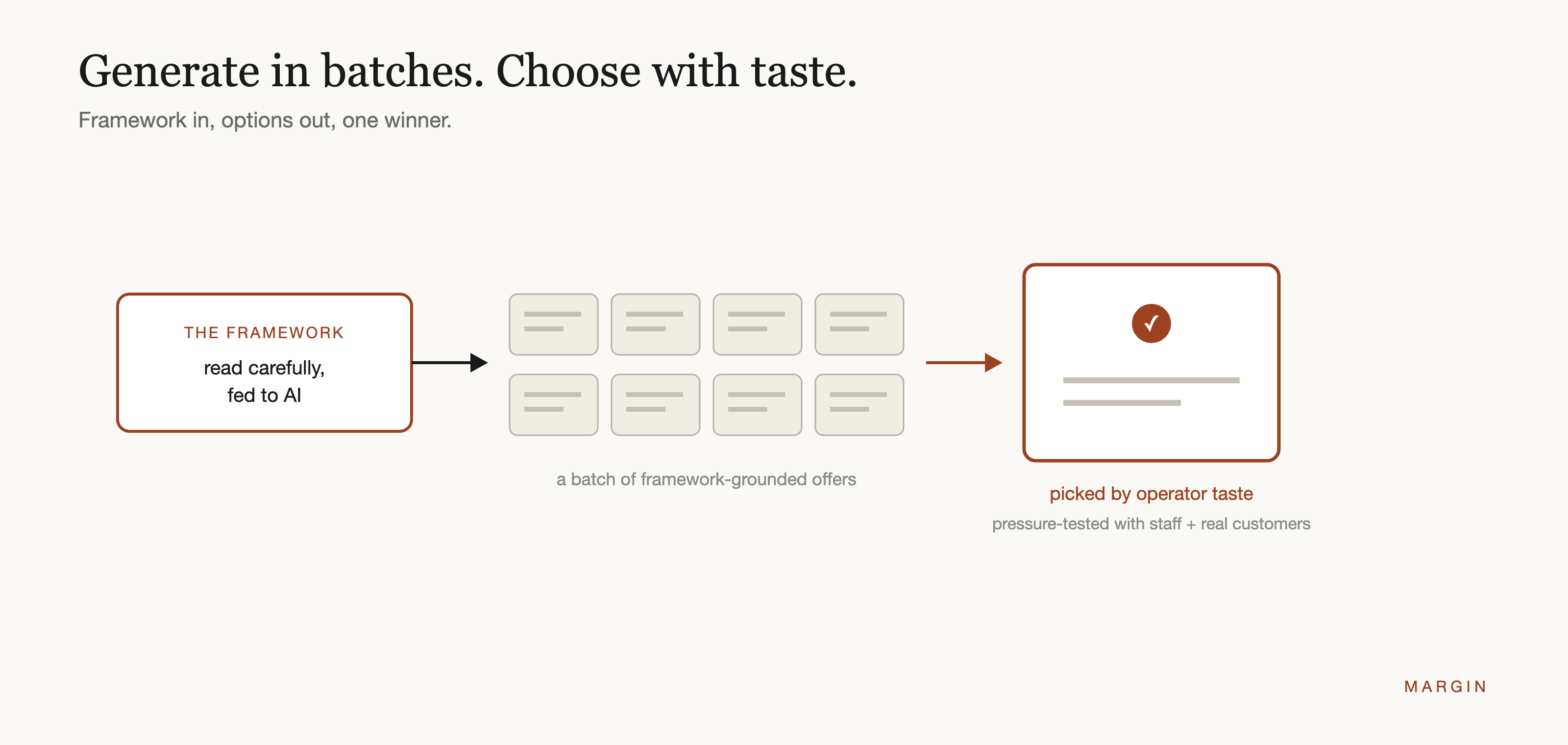
Feed AI a proven framework, generate a batch of options, and pick the winner yourself. The offer (the guarantees, the locked install date, the price-lock) came from feeding the Hormozi framework to AI. Give AI the framework and the quality jumps far above the generic level. But AI cannot pick the winner for this studio.
We chose with operator taste, then pressure-tested the pick on the people closest to the truth, the staff and a handful of real customers.
Generation is cheap now. Selection is the skill.
What happened when the owner's ads went on
For its first seven months the new site ran before the owner ran his own Google Ads. Its online revenue was small, but it converted, which proved the funnel held. Then, in April 2026, the owner ran his own Google Ads. No clever targeting: the ads pointed traffic at the site we had built.
The owner's ads brought the traffic; the site we built caught it. Both mattered: ads buy the visit, and what the visit lands on decides whether it pays. And the part that made it land was not the AI. It was the three decisions above. The full build story, named and public, is in the Goldenwood case study.
This is also why a cheap "AI website" changes nothing. That is the 80% anyone can generate now. What you are actually paying for, from anyone you hire, is the last 20%. This was never a website project. It was a refactor of how the business catches, converts, and keeps demand.
Should you fix your website before running Google Ads?
Yes. Ads multiply whatever they land on, so the order decides whether spend becomes revenue or noise. Before you put a dollar into traffic, three questions tell you whether you are ready.
Does a stranger understand, in five seconds, why you and not someone else? Not your name. Your difference, visible on the first screen.
Does an enquiry hit a real system, or a dead inbox? A form that emails a mailbox nobody checks is a leak wearing a form's clothes.
Have you built the thing that converts, or are you buying traffic to hide that you haven't? Conversion before you scale traffic, even small, is the proof. This studio had seven months of it before the owner ran his own ads.
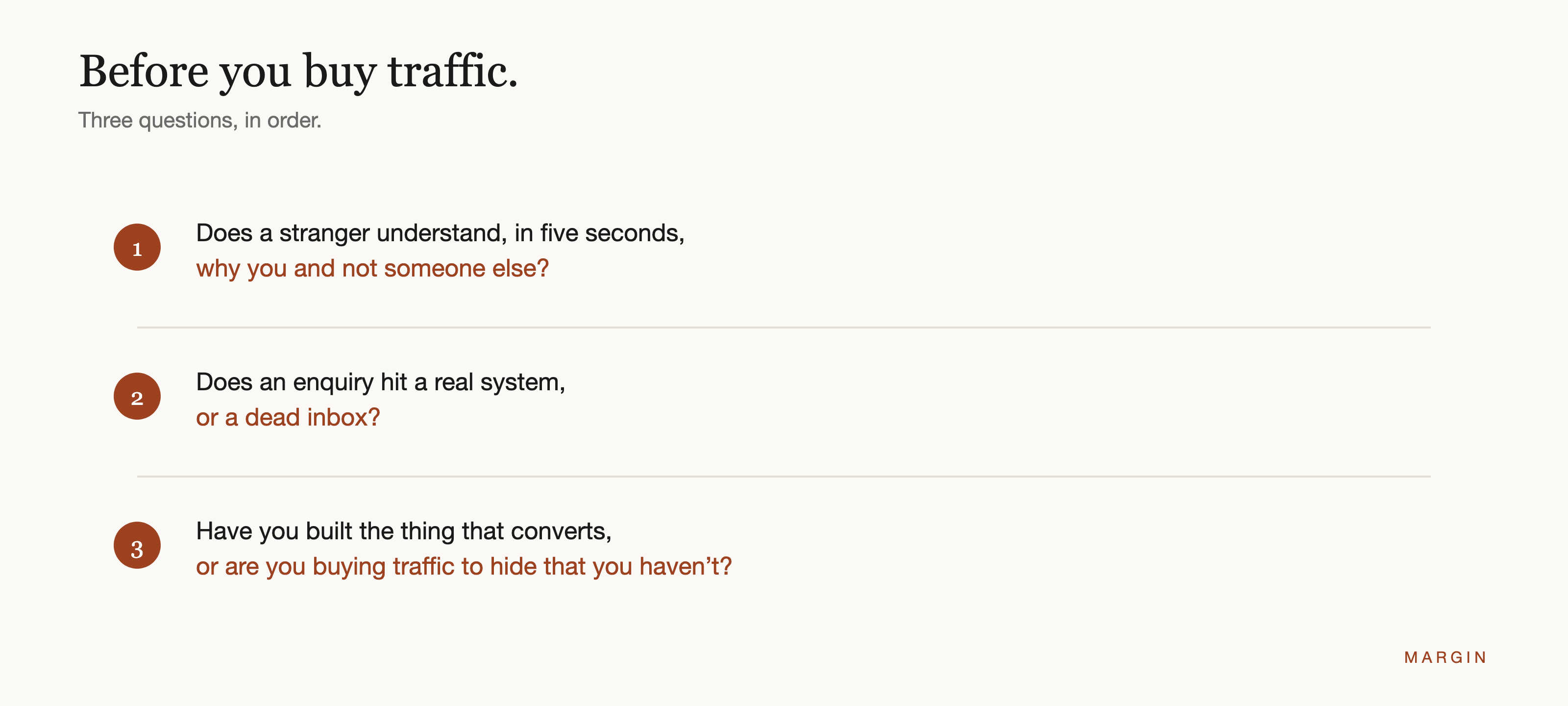
If you cannot answer all three with a straight face, fix that before you buy traffic. If you want to talk it through, get in touch.
We build in this order on purpose: diagnose the leaks, seal the conversion path, prove it converts on whatever traffic exists, and only then put money behind it. AI does the generation. The postulate, the build order, and the picking are judgment, and that is the part you are paying for.
AI is just a tool. It always was. The product is revenue, leads, and time, and those still come from judgment.
Should I fix my website before running Google Ads?
Yes, and the order is the whole point. In this case study the rebuilt site converted visitors for months before the owner ran his own Google Ads, which proved the funnel held. In April 2026, with the owner running his own Google Ads to the first site we built for him, online revenue that month was about 6× the seven months before combined, by the owner's own count. This was before the current system existed. Traffic multiplies conversion. It cannot create it.
What should be in place before I spend on ads?
One converting path: a landing page that carries the brand, product imagery worth wanting, copy in your customers' own words, a form and booking that land in a real database, and every contact point answered. Catalogue depth, backstory, and blog content can all wait.
Did Google Ads cause the 6× month?
Both deserve credit. The owner's own ads brought the traffic, and the site we built caught it. That site had already been converting visitors for months, so the paid traffic landed on a funnel that held. Point the same traffic at a leaky funnel and you get spend, not revenue.
Can AI build a website that converts?
AI can generate the site, the copy, and the imagery. In this build it did most of that. What it could not do is the three decisions that made the site convert: postulate the positioning, order the build so the funnel sealed first, and pick the winning offer with taste.