Capability

Things we built to find out whether they could be built.

Nobody asked for these and nobody paid for them. They are concept builds, made to test how far a small team can take a website before anyone signs anything.

Read these as demonstrations, not case studies. Every brand below is invented. None of them is a client, none of them commissioned the work, and none of them paid for it. There are no results attached because there are no results to attach — nothing here has ever had a real customer.

Margin has one real client engagement, and it is on the work page, with its numbers.

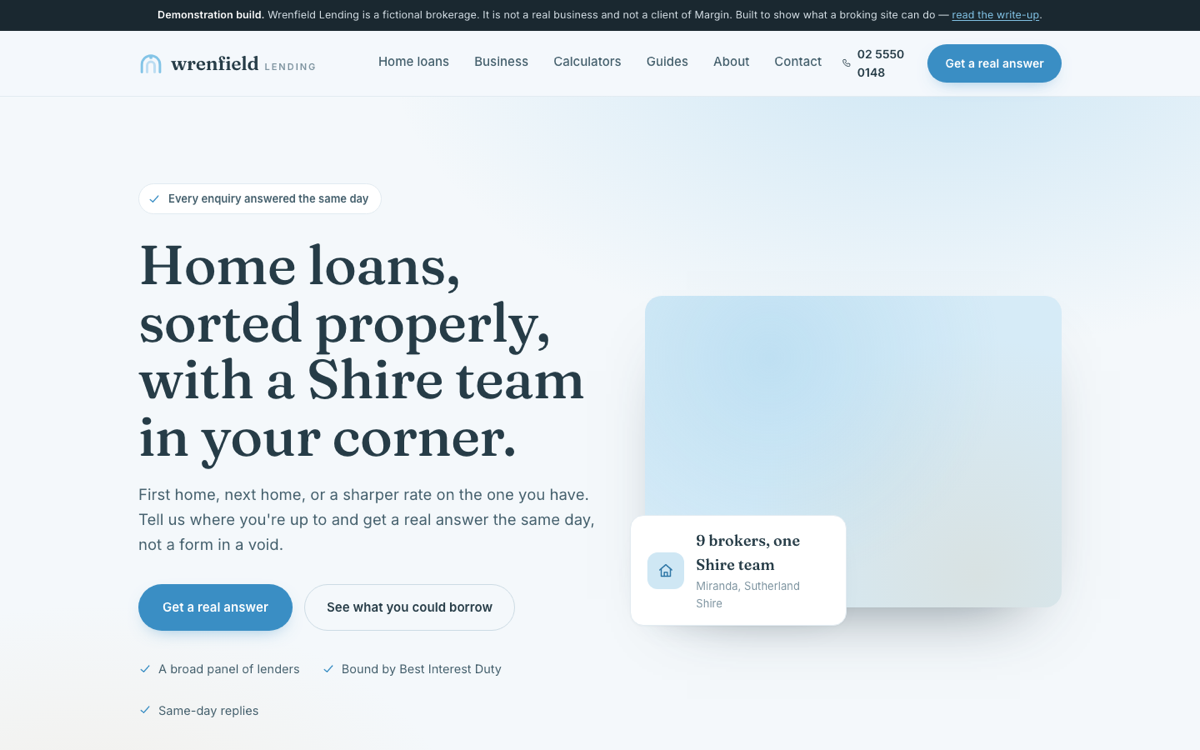
The Wrenfield Lending demonstration build
Mortgage brokingConcept build

A broking site that answers the enquiry instead of collecting it.

62 pagesproduct pages, guides, calculators and legals

Most broker sites end at a contact form, and the form is where the enquiry dies. Somebody types a question at 9pm, gets an auto-acknowledgement, and hears nothing until Tuesday. The build puts a qualifying desk in front of that: it reads what the person is actually trying to do, asks the two or three things that decide the answer, and commits to a same-day reply. Everything else — the borrowing calculators, the loan-type explainers, the document checklists — exists so that somebody researching at 9pm can get far enough on their own to be worth replying to.

  • A qualifying enquiry desk that builds a brief, not a name-and-email capture
  • Borrowing and repayment calculators, wired into the same brief
  • Six business-finance products and six home-loan journeys, each a full page
  • Guides, blog, complaints, privacy and terms — the whole trust surface
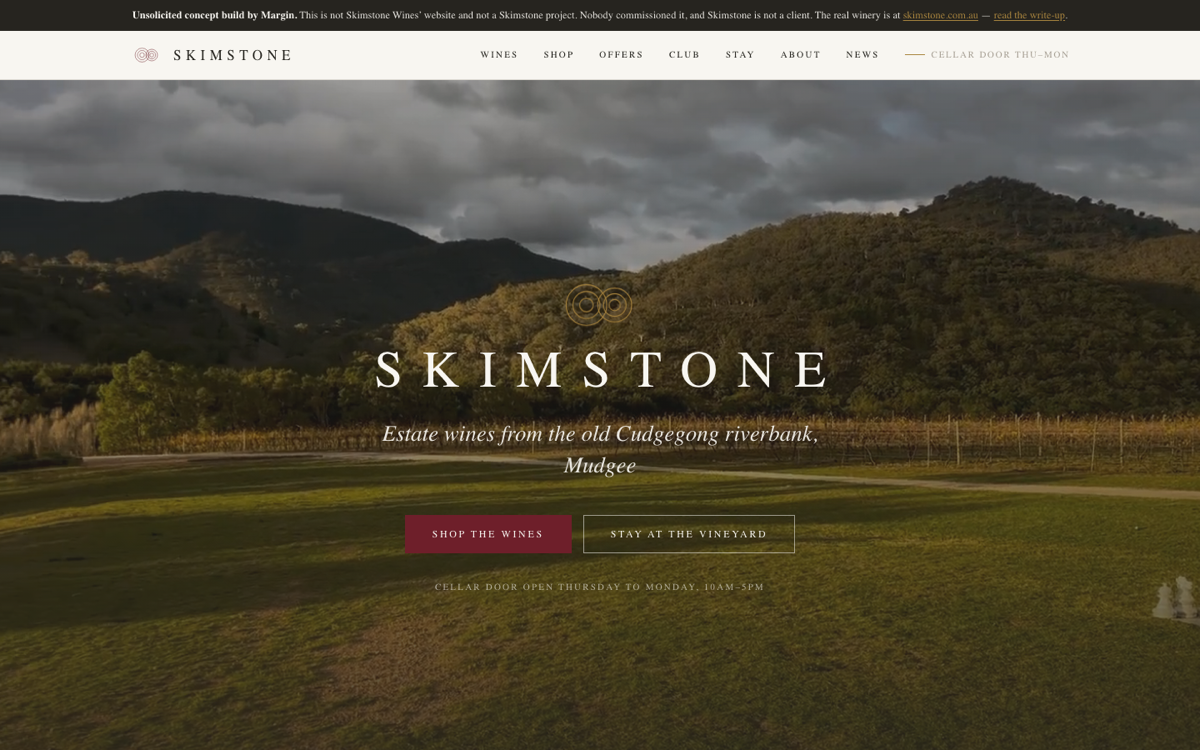
The Hollowmere Estate demonstration build
Boutique wineryConcept build

A cellar door, a wine club and a guesthouse, on one site that sells all three.

41 pageswines, shop, club, accommodation and estate story

Small wineries usually run three businesses off one site — bottles, a club, and beds — and the site is usually built for one of them. The other two get a paragraph. This build gives each its own path without splitting the estate into three brands: the wine range leads, the club is positioned as the thing that makes a visit repeat, and the guesthouse is sold as the reason to come at all. The shop carries every wine as its own page, because a wine that only exists inside a dropdown does not get found.

  • Thirty wines, each with its own page, range and tasting note
  • A wine club with a real sign-up path rather than an email link
  • Guesthouse pages sold alongside the cellar door, not buried under it
  • An estate story built from the ground the vines sit on
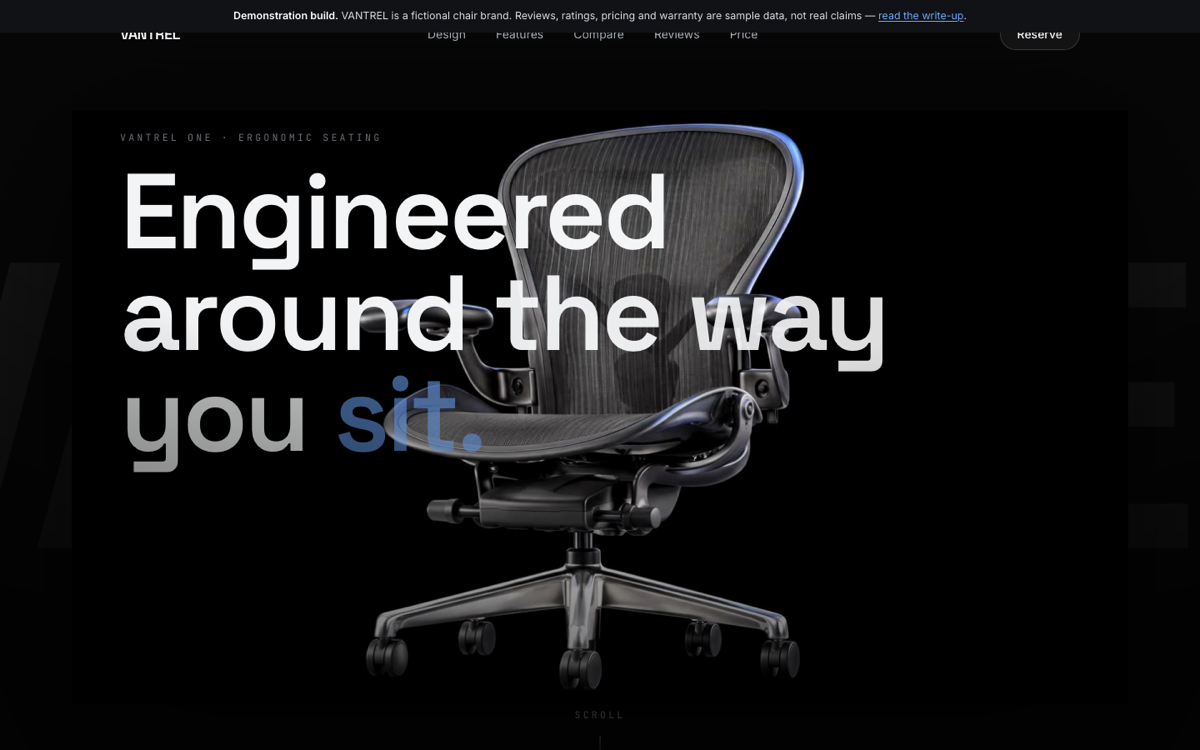
The VANTREL One demonstration build
Product launchConcept build

A scroll-driven product launch, then the conversion layer under it.

Single pagescroll-scrubbed hero, exploded view, conversion band

This one started as a question about motion — whether the pinned, scroll-scrubbed product film that premium brands use could be built reliably rather than as a one-off. The hero scrubs through the product as you scroll and the whole thing comes apart into its components under a spotlight. Then the second half asks the harder question: motion that does not sell anything is a showreel. So the page carries the decision layer too — comparison, financing shown at the price, and the reasons-to-trust placed where the hesitation actually happens.

  • A pinned hero that scrubs through the product on scroll
  • An exploded view that separates the product into numbered parts
  • A horizontal gallery driven by vertical scroll
  • A conversion band: comparison, financing at the price, trust at the decision

Sample reviews, ratings and pricing throughout. The product renders depict an existing, widely recognised chair and stand in as reference imagery — the industrial design is not ours.

See if Margin fits your business

We take a small number of engagements and qualify every one. Two minutes to apply.